Cocci
Historical document, translated for reference. It reflects medical knowledge of the 1920s–30s and is not medical advice.
Summary
This article from the 1928–1936 Soviet Great Medical Encyclopedia defines cocci as spherical bacteria, detailing their classification based on division patterns and morphology. It covers various types such as streptococci, staphylococci, and sarcinae, and lists major pathogenic representatives alongside historical classifications.
Encyclopedia article (1928–1936)
COCCI, microbes having a spherical shape. Deviations from the typical spherical shape are not uncommon: sharpening of one of the poles up to the formation of lanceolate forms, elliptical forms, etc. (see figure). The size of cocci fluctuates within fairly
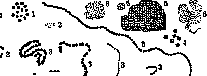
1- cocci; 2-diplococci; 3-streptococci; 4- tetracocci; 5-sarcinae; 6-staphylococci.
wide limits, and the smallest representatives of bacteria belong to this class; the size of a staphylococcus is below 1 μ (diameter 0.6-1.2 μ), pneumococcus - 0.5-1.0 μ x 0.5-1.5 μ; along with this, cocci are encountered that reach up to 5 μ in diameter. The reproduction of cocci occurs by means of division. If this division occurs only in one direction and the resulting cocci remain connected to each other, then a thread of spheres in the form of a necklace is obtained. Such forms are known by the name of chain cocci or streptococci. Groups of two cocci are called diplococci. Upon division alternating in two mutually perpendicular directions, groups of cocci arise, bearing the name of tetracocci if combinations of four microbes are formed; groups consisting of many individuals are called merismopedia. With regular division in three mutually perpendicular planes, groups of cells are formed in the form of more or less voluminous packets; such forms are called sarcinae. Finally, dividing without any particular order in various directions, cocci form groups of individuals resembling grape clusters; such forms are called staphylo- or cluster cocci. Cocci usually do not form spores; spores have been described only in very few species, e.g., in Sarcina ureae. Cocci are usually immobile and, in accordance with this, are devoid of flagella; only in a few species are flagella present (Micrococcus agilis, Sarcina ureae). According to the classification of bacteria adopted by the Committee on Characterization and Classification of the American Society of Bacteriologists (Bergey), cocci are combined into the family Coccaceae, consisting of the following genera: Neisseriae, Streptococcaceae, and Micrococcaceae. Neisseriae include Neisseria gonorrheae (gonococcus), N. intracellularis (meningococcus), and others; Streptococcaceae include Diplococcus (pneumococcus), Streptococcus (pyogenic streptococcus), and others; Micrococcaceae include Staphylococcus (St. aureus), Micrococcus (M. cerevis), and others. The most important pathogenic cocci are: pyogenic streptococci and staphylococci, pneumococcus, meningococcus, gonococcus, enterococcus, micrococcus, and others. Many cocci bear special names, some of which have only historical interest. Such are galactococci (cocci isolated from pus during mastitis), iodococci—large and small (normal inhabitants of the oral cavity, isolated from dental plaque and characterized by the special reaction of their colonies to a solution of iodine in potassium iodide), Pasteur's cocci (isolated by him in cases of rabies), lactococci (white cocci isolated from milk and related to the pyogenic micrococcus), Dufougère's lymphococci, isolated by him in cases of elephantiasis, trachoma cocci, etc. Cocci similar to certain pathogenic cocci but not possessing pathogenicity deserve separate mention; such are gonococcus-like cocci (see Gonococcus), pseudomeningococci (see Meningococcus), etc.
Related articles
Mentioned in
Cite this page
“Cocci.” Soviet Medical Encyclopedia. English translation of Bolshaya Meditsinskaya Entsiklopediya, 1st ed. (Moscow, 1928–1936), ed. N. A. Semashko. https://sovietmedicalencyclopedia.com/article/cocci/