Verbov Binder
Historical document, translated for reference. It reflects medical knowledge of the 1920s–30s and is not medical advice.
Summary
The Verbov binder is an abdominal support device designed to assist women during the expulsion stage of labor by reinforcing the abdominal wall and supporting the contracting uterus. Based on the theory of uterine peristalsis, this device was intended to accelerate labor and reduce the need for operative interventions, with its use controlled by the patient herself.
Encyclopedia article (1928–1936)
VERBOV BINDER, an abdominal binder designed to assist a woman in labor during the expulsion stage.
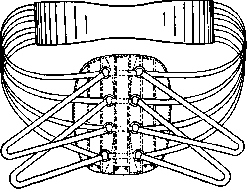
The action of the binder is based on the law of peristaltic movement of the uterus, formulated by Verbov in 1912. According to the author, the binder should prevent stretching of the abdominal wall and provide support to the contracting uterus, enhancing its expulsive capacity. The Verbov binder consists of two halves connected to each other by a system of cords looped through rings; the front panel is reinforced with steel stays sewn into the fabric. The American Beck (A. Beck) proposed an almost identical binder, but both of its halves are connected immovably by special buckles.
The binder is placed on the abdomen of the woman in labor, and during the bearing-down efforts in the expulsion stage, it is tightened, and upon the conclusion of the contraction, it is relaxed again. The action of the binder is controlled by the woman in labor herself. The binder can be used in all cases of normal labor, as well as in occipital and breech presentations. In pathological labor, the indications for it coincide with those for forceps. Contraindications: severe disproportion between the fetal head and the pelvis, heart and kidney diseases. Experience has shown that the Verbov binder facilitates and accelerates labor, reduces the percentage of operative interventions, and lowers maternal morbidity and infant mortality. The third stage of labor proceeds normally. In contrast to pituitrin, the action of the Verbov binder can be stopped at any moment. Lit.: Verbov Ya. F., The Woman's Uterus and Its Work During Labor, M.-L., 1924; Aleksandrov A., Application of a Binder to the Abdomen of Women in Labor, "Kazan Medical Journal", 1924, No. 9; Chistyakov N. E., Verification of Verbov's Doctrine on Normal Uterine Activity During Labor, "Practical Medicine", 1925, No. 7; Beck A., Abdominal binder as a substitute for pituitary, Journal of the American Medical Association, v. LXXXIII, No. 10, 1924.
Related articles
Cite this page
“Verbov Binder.” Soviet Medical Encyclopedia. English translation of Bolshaya Meditsinskaya Entsiklopediya, 1st ed. (Moscow, 1928–1936), ed. N. A. Semashko. https://sovietmedicalencyclopedia.com/article/verbov-bandage/