Gnathostat
Historical document, translated for reference. It reflects medical knowledge of the 1920s–30s and is not medical advice.
Summary
The gnathostat is an orthodontic device invented by van Loon and improved by Simon to determine the position of the jaw and dental apparatus relative to the main planes of the skull. By setting pointers on orbital and tragus points, clinicians can transfer anatomical data to a gypsum model to evaluate dental deviations.
Encyclopedia article (1928–1936)
GNATHOSTAT (from the Greek gnathos — jaw and Latin status — state), an instrument used to determine the position of the jaw and dental apparatus relative to the main planes of the skull, i.e., the so-called Frankfurt horizontal plane passing through the external auditory meatus and the lower margins of the orbit, the sagittal plane passing along the midline of the head from front to back, and the frontal plane passing through the outer margins of the orbit perpendicular to the horizontal plane (see figure). It was introduced by van Loon and improved by Simon. Its main parts are: an impression tray for obtaining a cast of the jaw and teeth, a metal rod 20 cm long, and a semicircular band moving up and down the rod with 4 arrows. These arrows are movable and can be fixed in any position. They are
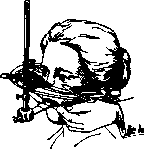
set at the orbital points and the points of the external auditory meatus (tragus). Subsequently, using additional devices, the obtained data are transferred to a gypsum model, thus obtaining lines by the position of which one can judge various anatomical deviations. The impeccability of gnathostatic data is disputed by the American school of orthodontists.
Related articles
Mentioned in
Cite this page
“Gnathostat.” Soviet Medical Encyclopedia. English translation of Bolshaya Meditsinskaya Entsiklopediya, 1st ed. (Moscow, 1928–1936), ed. N. A. Semashko. https://sovietmedicalencyclopedia.com/article/gnathostat/