Colpopoesis
Historical document, translated for reference. It reflects medical knowledge of the 1920s–30s and is not medical advice.
Summary
This article from the 1928–1936 Soviet medical encyclopedia details the historical development of surgical techniques for creating an artificial vagina. It covers early, often unsuccessful, attempts at skin transplantation and the later, more effective methods involving the use of intestinal tissue to treat vaginal agenesis.
Encyclopedia article (1928–1936)
COLPOPOESIS (colpopoesis), the creation of an artificial vagina. Ancient physicians already relatively often observed the complete or partial absence of internal genital organs. Among these defects, the partial or complete absence of the vagina was particularly noteworthy. This defect inevitably makes itself known by the absence of menstruation at an age when menstruation should have already appeared, and in the presence of a uterus capable of secreting menstrual blood, by the formation of blood tumors from accumulating blood (haematometra, haematocolpos, haematosalpinx). In the absence of a uterus or in its rudimentary state, blood tumors do not form, and often a woman learns of her defect only after marriage and consulting a physician. In rare cases, the absence of the vagina is a consequence of the obliteration of its lumen under the influence of various inflammatory processes, especially in early childhood. The operation aimed at creating an artificial vagina to replace the missing one, in order to provide an outlet for menstrual blood in the presence of a menstruating uterus, to eliminate the formation of blood tumors, and also to enable a woman, even one deprived of a menstruating uterus, to live a normal sexual life, has its own history. In the case of the development of blood tumors, the formation of an artificial passage in place of the missing vagina is usually a life-saving operation to relieve the woman of a gradually increasing blood tumor, which often threatens rupture and severe complications, and also to stop often severe pain, which is especially intense during periods corresponding to menstrual days. Physicians of the ancient world were already familiar with these sufferings (Hippocrates, Aristotle, Pliny, Celsus) and, to relieve women of them, had to resort to puncturing such tumors. With the development of surgery, physicians attempted to improve these punctures by replacing them with the creation of an artificial passage in the place where the vagina should be located. However, all these attempts in the pre-antiseptic period usually ended very tragically: the emptied cavity was easily infected from the wound opening, and patients often died from septic infection. Furthermore, even in cases that ended relatively successfully, the artificially created passage quickly closed, and the entire effect of the operation was nullified. Thus, despite the fact that the operation proposed by Dupuytren in 1817 made it possible to create a voluminous artificial vagina, it still did not lead to the desired results, as this passage also quickly closed through scarring. The conquests of the antiseptic era allowed for a persistent struggle to begin for the preservation of the artificially formed vaginal passage. Attempts were made not only to create an artificial passage but also to epithelize it by transplanting skin or mucous membrane onto the inner surface of the newly created vagina. The so-called plastic method appeared. For this transplantation, the material used consisted of the nearest areas of skin from the labia, perineum, or thighs, which remained connected by a thin pedicle to the site from which such a flap was taken (autoplasty). Free transplantation of skin flaps was also performed, in which no connection of the transplanted areas with the parent soil was left (autotransplantation). Finally, attempts were made to use skin or mucous membrane from other patients (heteroplasty) and even from animals for transplantation. However, all these methods only improved the results of the Dupuytren operation; they only temporarily delayed the subsequent process of scarring of the artificially created passage. As a rule, the final result was the obliteration of such a passage, even an epithelized one, and the result of the operation was reduced to nothing. It should be noted that Russian physicians hold a particularly honorable place in the creation of an artificial vagina. Thus, Gepner (St. Petersburg) was the first to have the brilliant idea of using a skin flap taken from the patient's labia majora and buttocks, formed according to the Dupuytren method, for transplantation into the vagina. Shalita (Kiev) first proposed transplanting islands of mucous membrane, cut with scissors from the inner surface of the patient's labia majora and minora, into the vagina. Much was done for the development and gaining of citizenship for this operation by Rein (Kiev), and especially by Snegirev (Moscow) and Popov (Leningrad). In the pre-antiseptic period, the operation to create an artificial vaginal passage was performed for only one purpose: to eliminate the formation of blood tumors and to create conditions under which blood released during menstruation would find a free exit to the outside. With the development of antisepsis, when the results of this operation began to improve significantly, reports gradually began to appear about cases of colpopoesis performed with the aim of giving a woman the opportunity to live a normal sexual life. The necessity of such indications was also dictated by the circumstance that the majority of married women with an absence of the vagina lived a sexual life anyway, but coitus was performed either into an artificial indentation in the perineal region created under its influence or through the dilated urethra. Such "broad" application of the operation caused a whole explosion of indignation and heated disputes in the medical world and in scientific societies. Should a physician, by creating an artificial vagina, pander to the desire of a woman and her husband to have a sexual life when the main goal of sexual intercourse—the possibility of pregnancy—is absent? A whole series of opponents of this operation appeared, striving to prove all its fruitlessness, ineffectiveness, and immorality. However, along with this, ardent defenders of this operation also appeared, proving that "a surgeon has the right and must intervene with active assistance to restore a missing organ, even if it is not entirely perfect. These operations are not only fully indicated, but they must be regarded as a noble duty of the surgeon" (Rein). At the present time, with the exception of a few individuals, there are few surgeons who deny the important significance of this operation, especially since its necessity, as has been clarified in a large number of cases, is also dictated by a number of factors of a psychic nature. As noted, the transplantation method did not yield lasting results despite persistent measures to delay the process of epithelial displacement and its replacement by connective tissue. Various bodies made of glass, ebonite, metal, and other materials were introduced into the newly formed vagina. These bodies were given a spherical, cylindrical, or some other shape; they were inserted for months, and yet the newly formed vagina slowly obliterated. In 1897, Ott first applied the method of using the peritoneum to avoid the desolation of the vagina. After the formation of an artificial passage and the opening of the peritoneum in the depth of the formed channel, he brought down the edges of this peritoneum to the level of the skin incision, to which he sutured the edges of the peritoneum. Even earlier, Pfannenstiel formed a similar passage and, having reached the cervix of the existing uterus, brought it down and sutured the edges of the skin incision to it. But both these methods did not receive wide distribution because they were significantly inferior in their results to methods that appeared almost simultaneously with them, the idea of which was to use a tubular organ—a section of the small or large intestine—for the formation of the vaginal tube. The first attempts in this area were made by Gersuny. However, they did not yield the desired results. In Russia, this idea was used in an extremely original form by Snegirev, who, despite the fiercest attacks, laid a serious and deeply thought-out foundation for the modern colpopoesis operation. Snegirev's idea is extremely simple. He separates the lowest section of the rectum from the one located higher up. Having performed a resection of the coccyx, he sutures the edge of the upper section of the intestine into the region of the resected coccyx and thus creates an anus praeternaturalis; the lower segment of the intestine serves as the vagina. To expand the anal opening and bring it closer to the labia, Snegirev makes an incision from the side of the anus along the midline of the perineum to the external opening of the urethra and sutures the incised mucous membrane of the rectum into this wound. Thus, a large, elongated introitus is obtained, in the formation of which the anal opening also participates. Snegirev's operation was modified and significantly improved by Popov. He freed it from the unpleasant aspects of an anus praeternaturalis, left the anal opening in its place, but formed the vagina from the lower section of the rectum. Popov achieved this by, like Snegirev, detaching the lower section of the rectum from the sacrum, separating this section of the intestine from below from the anal opening, and from above from the upper section of the same intestine; he brought the upper section of the intestine down to the anal opening and fixed it there with interrupted sutures, and moved the lower, isolated section of the rectum to the site of the vaginal tube he had formed and fixed it there.
A little later than Popov, the German gynecologist Schubert proposed his own method, which does not essentially differ from the Popov operation (Fig. 1). The difference lies only in the method of approach to the rectum. To separate the intestine and isolate its lower segment, Schubert uses the method already proposed by Snegirev
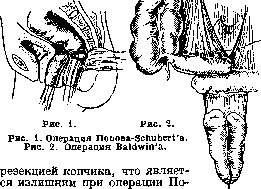
Popov. In any case, both operations are based on the same idea of Snegirev, but Popov carries it out with less trauma and with the same final results. With the development of abdominal surgery, the exclusively vaginal route for the formation of an artificial vagina was replaced by an operation involving the opening of the abdominal cavity through the anterior abdominal wall. This became necessary in order to use the lower sections of the small or large intestine for the formation of the vagina. For the first time, such an operation was proposed and performed by the American surgeon Baldwin (Baldwin; Fig. 2). The idea of this operation, which was developed in detail by Stoeckel, is extremely simple: a passage is made, as always, at the site of the absent vagina (partly with sharp instruments, partly by blunt dissection); a curved sponge forceps is inserted into this passage, after which the patient is positioned for laparotomy, the abdominal cavity is opened along the midline, a section of the small intestine is found as close as possible to the cecum, its most mobile loop, 25 cm in length, is isolated, leaving the isolated section on the mesentery and trying not to damage the mesenteric vessels supplying the isolated section. Intestinal patency is restored by anastomosis, and the isolated section of the intestine, after piercing the mesentery in the middle with a thick ligature, is pulled by this ligature into the artificial passage described above using the inserted sponge forceps (Fig. 2). After this, it only remains to suture the lower edge of the loop of the resected section of the small intestine into the skin wound of the introitus, open the intestine there, and the artificial double vagina is ready. Of course, the abdominal wall is sutured tightly. This operation, when performed correctly and with the preservation of the integrity of the mesenteric vessels, yields excellent results both in terms of primary surgical consequences and long-term ones.
At the present time, the vast majority of gynecologists use either the Popov-Schubert operation or the Baldwin operation. A heated debate about the advantages of one method or the other is being attempted to be resolved by references to the already sufficiently extensive material on both operations that is accumulating at the present time. The Popov-Schubert method is widespread especially in the USSR and in Germany; the Baldwin method is used for operations both in these countries and everywhere else. Among Russian gynecologists, the Baldwin method has also recently begun to gain many supporters, judging by the increasingly frequent reports. Both the method of forming an artificial vagina from the rectum and the Baldwin operation provide a good and permanent vagina, fully suitable not only for sexual life but even for childbirth, as indicated by the case of Wagner.
The method of forming an artificial vagina from the rectum, as well as the Baldwin operation, provide a good and permanent vagina, fully suitable not only for sexual life but even for childbirth, as indicated by the case of Wagner.
Related articles
Cite this page
“Colpopoesis.” Soviet Medical Encyclopedia. English translation of Bolshaya Meditsinskaya Entsiklopediya, 1st ed. (Moscow, 1928–1936), ed. N. A. Semashko. https://sovietmedicalencyclopedia.com/article/colpopoiesis/