Bronchomycoses
Historical document, translated for reference. It reflects medical knowledge of the 1920s–30s and is not medical advice.
Summary
This article from the 1928–1936 Soviet Medical Encyclopedia discusses bronchomycoses, which are respiratory tract diseases caused by molds and other fungi, most notably actinomycetes and Aspergillus species. It details the pathology, clinical presentation, and relationship to pneumomycoses.
Encyclopedia article (1928–1936)
BRONCHOMYCOSES (from the Greek bronchos — bronchus and mykes — fungus), diseases of the respiratory tract caused by fungi—molds and other closely related species. Most frequently, the causative agents are varieties of so-called ray fungi, actinomycetes (Actinomyces, Streptothrix). Fixing themselves initially on the mucosa of the small bronchi, these fungi mostly provoke the development of specific granulations there, which rapidly spread to the neighboring alveolar parenchyma and widely throughout the organ, due to which both in the clinical and anatomical picture of the disease, lung involvement (pneumomycosis) always comes to the fore. In other, much rarer cases, the disease remains confined for a long time to the bronchial system,
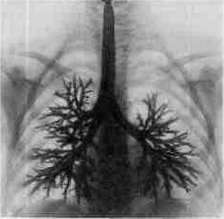
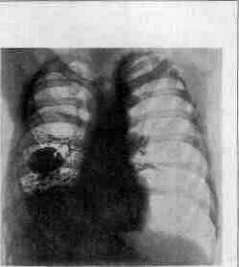
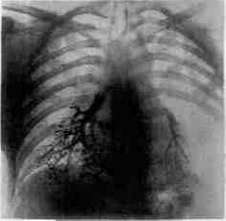
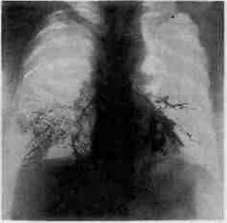
running initially as a protracted bronchial catarrh. However, here too, over time, there occurs, on the one hand, a deeper and more significant damage to the bronchial wall (deep and extensive infiltrates, partial necroses and suppurations, development of granulation foci, formation of bronchiectasis, etc.), and on the other hand, involvement of the pulmonary parenchyma in the process (interstitial and exudative pneumonias, sometimes with subsequent necrotization or carnification). Thus, phenomena on the part of the lung also significantly predominate here (see Pneumomycoses). Among lower mold fungi, the causative agents of such diseases can be Aspergillus fumigatus, less often Aspergillus niger, and even more rarely Mucor (hence the name of the disease — mycosis aspergillina s. aspergillosis et mycosis mucorina). Infection of a healthy respiratory tract with the named fungi occurs in exceptionally rare cases. This requires some prior disease of the airway system or lungs (chronic bronchitis, prolonged pneumonia, infarctions, etc.). The fixation and reproduction of fungi occur especially easily in the stagnating secretion of bronchiectatic cavities and other cavernous formations of the lung (abscesses, old tuberculosis cavities, foci of gangrene, etc.), where the fungi, proliferating, either form a coating along the walls or accumulate in the form of more voluminous lump-like, sticky masses of dark brown, greenish, yellowish, or gray color. Besides mold fungi, blastomycetes can also occasionally cause the development of granulation or purulent foci in the respiratory organs. The latter, however, never arise primarily, aerogenically, but exclusively via hematogenic metastases, being a complication of chronic skin blastomycosis. By their nature, the changes observed here already entirely belong to the category of pneumomycoses (see Pneumomycoses; see also bibliography there).
M. Skvortsov.
Related articles
Mentioned in
Cite this page
“Bronchomycoses.” Soviet Medical Encyclopedia. English translation of Bolshaya Meditsinskaya Entsiklopediya, 1st ed. (Moscow, 1928–1936), ed. N. A. Semashko. https://sovietmedicalencyclopedia.com/article/bronchomycoses/