Statocysts
Historical document, translated for reference. It reflects medical knowledge of the 1920s–30s and is not medical advice.
Summary
This article from the 1928–1936 Soviet Medical Encyclopedia describes statocysts, or auditory vesicles, as organs of equilibrium found in various invertebrates such as coelenterates, worms, mollusks, crustaceans, and some tunicates. It details their structure, which typically consists of an epithelial-lined fluid-filled vesicle containing statoliths that stimulate sensory cells to provide spatial orientation.
Encyclopedia article (1928–1936)
STATOCYSTS, or auditory vesicles, are organs of equilibrium consisting of an open (Fig. 1) or closed vesicle (Fig. 2) of ectodermal origin. The vesicle is filled with fluid containing one or more statoliths or otoliths (ear stones). In open statocysts, grains of sand may play this role. Statocysts are lined with epithelium and innervated by special nerves. The epithelium is either uniform or differentiated into intermediate, ciliated, and sensory cells (Fig. 2). With different body positions, the otolith presses on various parts of the statocyst wall, which is perceived by the animal as a sensation of normal Longitudinal
section through the statocyst orientation of the body in space. pro
Arenicola marina: 1 — opening
entrance opening; 2 — space. puncture and.
cilia of the epithelium; 3 — connect also with the perception of auditory stimuli, which is why statocysts are often called auditory vesicles. Statocysts are found in coelenterates, worms, mollusks, crustaceans, and some 4 — connective tissue. (From Bütschli.)
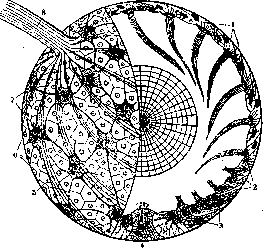
Figure 2. Statocyst of Pterotrachea; the left half of the statocyst is shown intact, the right in section. Bundles of cilia are shown in a state of rest: 1 and 7 — ciliated cells; 2 and 6 — intermediate cells; 3 — sensory cells; 4 — central sensory cell; 5 — nerve fibers; 8 — auditory nerve. (From Bütschli.)
tunicates. In vertebrates, they are functionally equivalent to the labyrinth.
Related articles
Mentioned in
Cite this page
“Statocysts.” Soviet Medical Encyclopedia. English translation of Bolshaya Meditsinskaya Entsiklopediya, 1st ed. (Moscow, 1928–1936), ed. N. A. Semashko. https://sovietmedicalencyclopedia.com/article/statocysts/