Crustaceans
Historical document, translated for reference. It reflects medical knowledge of the 1920s–30s and is not medical advice.
Summary
This article provides a biological overview of the class Crustacea, detailing their anatomical structure, including the chitinous exoskeleton, segmented body, and specialized appendages. It also categorizes various orders of crustaceans, noting their ecological roles and their significance as intermediate hosts for certain human parasites.
Encyclopedia article (1928–1936)
CRUSTACEANS, Crustacea, a class of the phylum Arthropoda, characterized by the presence of an external chitinous skeleton and a segmented body; in many crustaceans, the skeleton forms a shell (crusta) covering the anterior part of the body from above and the sides (hence the name Crustacea). The segmented body forms a head and a trunk. Some trunk segments may fuse with the head, in which case they form a cephalothorax; the rest of the body is called the abdomen. In typical representatives, the head bears 5 pairs of appendages: 2 pairs of antennae, a pair of mandibles (upper jaws), and 2 pairs of maxillae (lower jaws). Depending on the fusion of the trunk segments with the head, a corresponding number of pairs of legs are transformed into the maxillipeds of the cephalothorax. The body segments typically bear a pair of biramous appendages, called legs. The main shaft of the leg splits into two branches—the outer (exopodite) and the inner (endopodite). The exopodite may be underdeveloped.
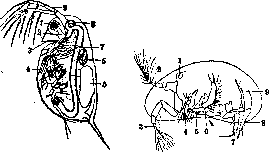
Figure 1.
Figure 2.
Figure 1. Representative of Cladocera—Daphnia: 1—eye; 2—nerve ganglion; 3—antennula; 4—swimming legs; 5—brood chamber; 6—heart; 7—shell gland; 8—digestive gland; 9—antenna. (After Claus.) Figure 2. Representative of Ostracoda—Cypris: 1—median eye; 2—antennula; 3—antenna; 4—upper jaw; 5 and 6—lower jaws; 7 and 9—thoracic legs; 8—abdomen. (After Gerstaecker.)
The limbs often bear various appendages (e.g., gills) and can vary greatly in their form (e.g., flattened legs, claws, etc.). The growth of crustaceans is associated with molting, when the old chitinous shell is shed and replaced by a new one. The hardness of the chitinous skeleton depends on the deposition of calcareous salts in it. Crustaceans are aquatic inhabitants (marine and fresh water). They breathe with gills, which are appendages of the legs or adjacent parts of the body. The circulatory system is open, with a heart lying on the dorsal side of the body. The nervous system is chain-like, consisting of a supraesophageal ganglion and a ventral nerve chain. Sensory organs are well developed. They are dioecious or hermaphroditic. They lay eggs, from which a typical six-legged larva emerges—the nauplius, which often undergoes a complex metamorphosis.
Figure 3. Representative of Copepoda—Cyclops: 1—cephalothorax; 2—thoracic segments; 3—post-abdomen; 4—first segment; 5—ovary; 6—antennula; 7—median eye.
In most cases, crustaceans lead a mobile lifestyle; there are also sedentary and parasitic forms. They feed as predators, devour corpses, or parasitize at the expense of other crustaceans or fish. Some serve as an important source of food for humans. Small forms and stages of metamorphosis are part of the plankton and characterize the degree of pollution or purity of water in a reservoir.
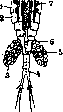
Crustaceans are divided into orders: Phyllopoda—leaf-footed crustaceans [e.g., inhabitants of salt waters—Artemia; water fleas or Daphnia (Fig. 1), etc.]; Ostracoda—seed shrimp with a body covered by a shell (Cypris, Fig. 2); Copepoda—copepods [Cyclops—Cyclops strenuus (Fig. 3)—the first intermediate host of the broad fish tapeworm; C. coronatus, C. quadricornis, C. viridis, etc.—intermediate hosts of the Guinea worm; Diaptomus gracilis—the first intermediate host of the broad fish tapeworm; a number of copepod forms parasitize fish]; Cirripedia—barnacles [sedentary—acorn barnacle—Balanus (Fig. 4) and parasitic—Sacculina, etc.]; Decapoda—ten-legged crustaceans (Potamobius fluviatilis—crayfish, Homarus vulgaris—lobster, Crangon crangon—shrimp, various crabs—all are used for food; Astacus japonicus and crabs—Sesarma dehaani, Eriocheir japonicus, Paratelphusa sinensis, Potamon obtusipes, etc.—are the second intermediate hosts of the lung fluke) and other orders.
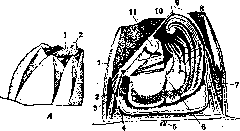
Figure 4. Balanus. A—from the outside: 1—scutum; 2—tergum; B—dissected: 1—shell; 2—oviduct; 3 and 7—muscles of the scutum and tergum; 4—ovary; 5—antennulae; 6—female genital opening; 8—edge of the shell; 9—tergum; 10—scutum; 11—adductor muscle.
E. Pavlovsky
Related articles
Mentioned in
Cite this page
“Crustaceans.” Soviet Medical Encyclopedia. English translation of Bolshaya Meditsinskaya Entsiklopediya, 1st ed. (Moscow, 1928–1936), ed. N. A. Semashko. https://sovietmedicalencyclopedia.com/article/crustacea/