Roser-Nélaton Line
Historical document, translated for reference. It reflects medical knowledge of the 1920s–30s and is not medical advice.
Summary
The Roser-Nélaton line is an anatomical landmark used to assess the position of the greater trochanter of the femur. It is defined as a line connecting the anterior superior iliac spine to the ischial tuberosity. In clinical practice, it helps diagnose hip joint dislocations, femoral neck fractures, and other pathologies.
Encyclopedia entry (1928–1936)
Roser-Nélaton line (Roser, Nélaton), a line drawn between two points: 1) spina ossis ilii superior anterior, 2) tuber ischii. Normally, the greater trochanter of the femur (trochanter major) is located on this line.
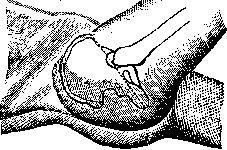
In cases of displacement of the femoral head (dislocation, destruction of the head by an inflammatory process) or shortening of the femoral neck (fracture), the greater trochanter is located above (rarely below) this line.

The examination is best performed with the patient lying on their side with the thigh brought toward the abdomen, connecting both points (sp. oss. il. sup. ant. and tub. ischii) with a thin thread. The Roser-Nélaton line serves as a great aid in the clinic of diseases of the hip joint and femoral neck, allowing for a correct diagnosis to be made even without X-ray examination.
Related articles
Cite this page
“Roser-Nélaton Line.” Soviet Medical Encyclopedia. English translation of Bolshaya Meditsinskaya Entsiklopediya, 1st ed. (Moscow, 1928–1936), ed. N. A. Semashko. https://sovietmedicalencyclopedia.com/article/roser-nelaton-line/