Radioactivity
Historical document, translated for reference. It reflects medical knowledge of the 1920s–30s and is not medical advice.
Summary
This article defines radioactivity as the spontaneous transformation of chemical elements accompanied by the emission of energy. It details the historical discovery of the phenomenon by Becquerel and the Curies, and describes the physical properties of alpha, beta, and gamma radiation.
Encyclopedia article (1928–1936)
RADIOACTIVITY, the property of certain chemical elements to spontaneously transform into other elements. This transformation, or radioactive decay, is accompanied by the release of energy in the form of various corpuscular and radiant emissions. The phenomenon of radioactivity was discovered in 1896 by Becquerel. He found that uranium salts produce emissions that act upon a photographic plate and impart electrical conductivity to the air. Further research showed that the emission of "Becquerel rays" is an atomic property of uranium, independent of the chemical compound in which it is found. Systematic studies of all known elements discovered that, besides uranium, only thorium possesses significant radioactivity (G. Schmidt and M. Curie, 1898). Subsequently, a weak radioactivity of potassium and rubidium was also discovered. Upon studying natural uranium compounds, it turned out that their radioactivity is significantly greater than would be expected based on their uranium content. The hypothesis put forward by M. Curie, that this anomaly is connected with the presence of unknown, highly radioactive elements in uranium minerals, was confirmed. Through long and painstaking work, P. and M. Curie managed to isolate from the uranium pitchblende of the Jáchymov deposit (Czechoslovakia) the new elements polonium (1898) and radium (1898), the radioactivity of which exceeds that of uranium many times over. This laid the foundation for the discovery of a series of new radioactive elements, or radioelements, the number of which reaches 40. Radioactive emissions. By their nature, the emissions of radioactive elements are not homogeneous. In 1902, E. Rutherford proposed the names alpha, beta, and gamma rays for the three types of radioactive emissions, which possess the following properties: alpha rays are formed by positively charged, rapidly moving material particles of atomic size and are weakly deflected in an electric and magnetic field in a direction corresponding to the deflection of canal rays; they are very strongly absorbed by matter; beta rays are particles of negative electricity (electrons); they Figure 1.

are deflected significantly more strongly by a magnetic field and are completely analogous to cathode rays. Their penetrability is significantly greater than that of alpha rays; gamma rays do not experience deflection in a magnetic field and carry no charge; they possess the greatest penetrability (Fig. 1). Alpha particles carry a double elementary positive charge equal to 9.55 × 10⁻¹⁰ CGSE. By their nature, they are identical to the nucleus of a helium atom; alpha particles fly out of the atom with a specific initial velocity characteristic of each alpha-emitting radioelement; this initial velocity lies within the range from 1.4 × 10⁹ to 2.06 × 109 cm/sec. In air, alpha particles, due to their large mass, move almost rectilinearly, gradually expending their kinetic energy during collisions with gas molecules and causing strong ionization. Alpha particles possess a specific flight range, after passing which they lose their charge and their ability to cause characteristic effects and become ordinary helium atoms. The magnitude of this flight range, or "path length," of alpha particles depends on the initial velocity of the particle and on the absorbing substance. The magnitude of the path length of alpha particles is characteristic for each radioelement and encompasses the range of 2.67–8.62 cm in air at 0° and 760 mm. In solids, alpha particles are stopped by a layer thickness on the order of 0.1 mm. Beta rays of most radioactive substances form several groups with different initial velocities, the distribution of which is studied by the deflection of beta particles in a magnetic field (beta-ray spectrum). The initial velocities of beta particles lie within the range from 8.7 × 10⁹ to 2.947 × 1010 cm/sec, i.e., up to 0.988 of the speed of light. When passing through matter, beta rays are scattered significantly more strongly than alpha rays, changing their velocity little. Their absorption occurs according to a law close to a simple exponential Id = I0e-kd, where Id is the intensity of the radiation that has passed through thickness d, I0 is the initial intensity, and k is the absorption coefficient. A characteristic value can serve as the thickness of a layer of some substance, for example, aluminum, which absorbs beta rays by half. For various beta rays, the magnitude of this layer is 0.001–0.05 cm of aluminum. The most hard beta rays of RaC are absorbed completely by 2 mm of lead. Gamma rays are by their nature completely analogous to X-rays and are characterized by a wavelength of 10-9–10-11 cm. The absorption of gamma rays is accompanied by scattering and the appearance of secondary beta and gamma rays. Approximately, the absorption is expressed by a simple exponential law I = I0e-μx, wherein in the first approximation the relation μ/ρ = Const is satisfied.
where q is the density of the absorbing substance. The value of μ for γ-rays of various radioelements ranges from 1,000 to 0.12, which corresponds to a thickness of a Pb layer absorbing half the rays of 10-4–5.5 cm. Theory of radioactive decay. To explain radioactive phenomena, Rutherford and Soddy proposed in 1902 the theory of atomic decay, which was fully confirmed by subsequent experiments. Atoms of radioactive elements are unstable formations and are subject to spontaneous decay, which is subject to the law of chance. In this process, intra-atomic energy is released in the form of radiation, and the atom undergoes a transformation, passing into another chemical element with completely different properties, e.g., the metal Ra turns into RaEm, an inert gas. The basic law of radioactive decay is formulated as follows: the quantity of substance ΔN, decaying in an element of time Δt, is proportional to the amount of it present N and the time interval Δt, i.e., ΔN = -λNΔt or Nt = N0e-λt, where N0 is the initial quantity, Nt is the quantity for the moment t. The coefficient of proportionality λ is called the radioactive constant, or the decay constant of the radioelement. More clearly, each radioelement is characterized by a half-life, i.e., the time interval during which its initial quantity decreases by half, or by the average lifetime τ. The half-life T, the average lifetime τ, and the radioactive constant λ are related to each other as follows: T = 0.6931τ = 0.6931/λ. For various radioelements λ = 1.3 · 10-15–1011 sec-1, accordingly T = 5.2 · 1017 sec (1.65 · 1010 years)–10-11 sec. Between λ and the range of α-rays R, there exists a relationship found empirically by Geiger and Nuttall: lgλ = -A + B lgR, where A and B are constants. A graphical representation of the Geiger-Nuttall law gives approximately three parallel lines for the three radioactive families U-Ra, Th, and Ac. This law has to be used, among other things, for determining the radioactive constants of rapidly decaying substances. Radioactive phenomena are not subject to any external influences affecting the electron shells of atoms. This indicates that radioactivity is a property of the atomic nucleus. Phenomena of radioactive decay are accompanied by the emission of α- or β-particles from the atomic nucleus. This circumstance provided the first proof of the complex structure of the atomic nucleus, which contains electrons, protons, neutrons, and He nuclei as structural elements. The regularities observed in the distribution of wavelengths of γ-rays and the velocities of β- and α-particles indicate the existence of stable states in the nucleus corresponding to certain energy levels; γ-radiations are apparently connected with intra-nuclear transitions of α-particles from one energy level to another, with the wavelength of the γ-ray being determined from quantum relations. During radioactive transformation accompanied by the emission of an α-particle from the nucleus, it must pass through a potential energy level significantly exceeding the particle's own energy that it possesses in the nucleus. From the point of view of classical theory, it is impossible to explain the emission of an α-particle from the nucleus through this "potential barrier." Theories of radioactive decay based on the principles of wave mechanics make it possible to explain the emission of α-particles from the nucleus. In this case, it is possible to find a theoretical expression for the relationship between the velocity of α-particles and the decay constant of the atom, which satisfies experimental data. Assuming that α-particles in the atomic nucleus possess the same energy with which they leave the nucleus during decay, we obtain an initial value for estimating the absolute values of energy levels in the atomic nucleus. These values are of the order of 106 volts (in the notation of atomic physics). Some authors assume that atomic nuclei are built exclusively of protons and neutrons without the participation of negative electrons. β-radiations of radioactive elements form, on the one hand, groups of electrons of certain velocities, in all probability appearing as a result of the photoelectric effect caused by the γ-radiation of the nucleus in the electron shells of the atom; on the other hand, β-particles flying out of the nucleus possess velocities of very different values (continuous magnetic spectrum of β-rays). β-transformation is recently associated with the decay of a nuclear neutron into a proton and an electron or with the transformation of a photon (a quantum of γ-radiation) in the nucleus into a positive and negative electron and the subsequent ejection of a negative electron from the nucleus. The energy relationships in the nucleus associated with β-radiation do not yet appear entirely clear. The study of the atomic nucleus is currently in a stage of rapid development, bringing brilliant and unexpected discoveries, e.g., the discovery of the neutron (a neutral particle whose mass is very close to the mass of the proton) and the positive electron, or positron.
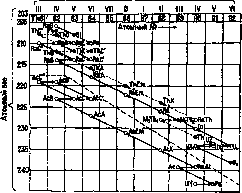
During the decay of a radioactive atom, a radioactive element is also usually obtained. Thus, decay series or radioactive families of successively transforming radioelements are formed. The law of radioactive decay makes it possible to calculate the quantity of any member of the series for any moment in time given the initial conditions. In practice, the following cases are the most important. 1) The decay of a single radioelement, for example, RaEm; the quantity of the radioelement at any moment is expressed as: Nt = N0e-λt; N0 is the initial quantity (at t=0). 2) Formation from a radioelement with a very long lifetime (the quantity of which practically does not change over the considered time interval), e.g., the formation of UX (half-life 24 days) from U (half-life 109 years). In this case, the number of atoms of the formed element N2 for the moment t is expressed through the number of atoms of the parent element N1 and the corresponding decay constants as: N2 = N2(0)e-λ2t + (λ1N1/λ2)(1 - e-λ2t). 3) The case of radioactive equilibrium, when a constant ratio of the numbers of atoms of successive elements in the decay series is maintained. In this case, the equalities are observed: N1λ1 = N2λ2 = ... = Nkλk, if the series under consideration contains k elements (Figure 2, growth and decay of ThX). The transformation of radioelements is always accompanied by α- or β-radiation. There is not a single known case where radioactive transformation is accompanied by only γ-radiation. The radiation of radioactive transformations led to the discovery of a large number of new elements. When attempts were made to place radioelements in the periodic system, difficulties arose, as the number of free places proved insufficient. These difficulties were overcome as a result of studying the chemical characteristics of radioelements. Boltwood, who discovered the new radioactive element ionium in 1906, showed that its chemical properties completely coincide with the properties of the element thorium. Subsequently, a similar chemical identity was discovered in a number of radioelements (Ra and MsTh, Po, RaB, ThB, AcB, etc.), and in 1910 Soddy suggested that these elements possess fundamentally identical properties and their separation by chemical methods is impossible. A group of such chemically indistinguishable elements is called, at the suggestion of Fajans, a pleiad, and the elements themselves, at the suggestion of Soddy, are called isotopes, as they occupy the same place in the periodic system. At the same time, Soddy suggested that non-radioactive elements might also be a mixture of fundamentally inseparable elements of different atomic weights, which explains the fractional values of the atomic weight of most elements. This idea of Soddy found brilliant confirmation in the works of Aston, who discovered isotopes of ordinary elements using the positive ray method. The concept of isotopy allowed all radioelements to be placed in the periodic system. They encompass 10 pleiads located in the last two rows of the periodic system (Figure 3). The characteristic elements or dominants of a pleiad of radioactive isotopes are the elements with the longest lifetime, or stable elements. At the same time, five of them, Ra, Em, Po, Ac, and Pa, are new elements that have occupied their own groups of the periodic system.
free places in the periodic system, while the rest fall into places occupied by previously known radioelements U and Th and inactive Pb, Tl, Bi. The greatest difference in the atomic weight of radioactive isotopes does not exceed 8 units. Thus, radioactive transformations allowed for a deeper insight into the physical meaning of the periodic law and the concept of a chemical element. It turned out that the position of an element in the periodic system is determined not by the atomic weight of the element, as was previously assumed, but by the magnitude of the positive charge of the nucleus of its atom. All properties of isotopes related to the electron shells of the atom, within the limits of the accuracy of our experiments, are practically identical (atomic volume, rate of transition from one state to another, thermal change in dimensions, magnetic susceptibility, spectra, etc.). They differ, apart from radioactive properties, only in those features that are related to the mass of the nucleus, for example, in the fine structure of the spectrum and in negligible differences in diffusion constants. Attempts to separate isotopes, which resulted in partial success after painstaking work, are based on this last circumstance.
During radioactive decay, the transformation of elements occurs, which obeys the following displacement rules (K. Fajans). 1) After the emission of an a-particle, the element shifts two places to the left in the periodic system. 2) During a β-transformation, the element shifts one place to the right (direction of the arrows in Fig. 3). These rules indicate that radioactivity is a property of the atomic nucleus, for the emission of an a-particle, carrying two elementary positive charges, reduces the charge of the nucleus by two units, which corresponds to a decrease in the atomic number by two units; a β-particle carries away one negative charge, i.e., it increases the positive charge of the nucleus, and consequently its atomic number by one. As a result of radioactive transformations, two different elements can occupy one and the same place in the periodic system.
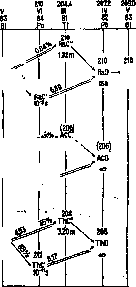
Radioactive families. All radioelements known to us form three radioactive families, or series: the U-Ra family, the Ac family, and the Th family. The U and Th series are independent, while the Ac series, according to all data, is connected with the U-Ra series, starting from one of the isotopes of uranium (actinouranium). Fig. 4 shows a diagram of radioactive families with their transformations. The greatest practical interest is presented by the radioelements Ra and MsTh, as they possess very high radioactivity and are a source of highly radioactive elements with a short life span (e.g., RaEm, ThX, and others).
Among other chemical elements, K and Rb possess weak radioactivity with the emission of β- and γ-rays. Apparently, only the isotope K with an atomic weight of 41 is radioactive, and the decay product is Ca with an atomic weight of 41, an indication of the presence of which in an ancient mineral containing K has been obtained analytically. The half-life of K is assumed to be on the order of 1012 years. It is possible that isotopes of uranium and thorium of different atomic weight also possess different radioactive properties. Hevesy recently discovered weak radioactivity of samarium with the emission of a-rays.
Radioelements in geophysics. Although industrial deposits of radioactive ores are encountered very rarely, radioelements in a dispersed state are distributed extremely widely in nature, and their presence can be detected thanks to the high sensitivity of measuring apparatus in practically any sample of rock or mineral. When studying the radioactivity of rocks, one usually limits oneself to the determination of the content of Ra and Th in them by the emanation method. In order of decreasing radium and thorium content, rocks are arranged as follows: acidic igneous rocks 2.5÷4 · 10-12 g Ra per 1 g and 1.6÷2.3 · 10-5 g Th per 1 g; basic rocks (basalts) 1.5 · 10-12 g Ra and 0.9 · 10-5 g Th; sedimentary rocks 0.9÷1.5 · 10-12 g Ra and 0.4÷1.4 · 10-5 g Th. In this case, the ratio of the quantity
Dominant Atomic weight 238.2
232.1
Valence VI IV Atomic number 92 Symbol U Th Radioactive elements and their genetic connection (230) (230)
20a 18, Sd 1,2d 3,92s 38m 2,16m Ra(210) 5-10s 232 228 228 228 224 220 216 212 212 Th-MsTh1-MsTh2-ThX-Th-ThEm-ThA-ThB-ThC 1,4s 10,6h 60,8m 1,65*10^10a 6,7a 6,13h 3,64d 54,5s 210 206 RaE-RaF-RaG 4,85d 138,5d Symbol U Atomic number 92 Valence VI Th 90 IV Ra Ac Th 90 IV Ra Em Bi Po 83 84 V VI -> denotes alpha-decay, Po Pb Bi Po Tl 84 82 83 84 81 VI IV V VI III Symbols and designations: -> denotes beta-decay, U-uranium, Th-thorium, Pa-protactinium, Ra-radium, Em-emanation, Po-polonium, Io-ionium, Ac-actinium, MsTh-mesothorium, RdTh-radiothorium, RdAc-radioactinium, Pb-lead. Figure 176.
The quantity of thorium and uranium is maintained approximately constant and equals on average 2.2. When considering the vertical distribution of radioelements in the earth, the following picture is obtained: in the outer granite shell 3*10^-12 g Ra; in the next basalt layer 0.77*10^-12 g Ra; in the sulfide layer 0.1*10^-12 g Ra and in the iron core 0.01*10^-12 g Ra. Such a distribution of radioelements plays a significant role in the thermal regime inside the earth. The radioelements contained in solid rocks, especially gaseous emanations, enter soil solutions and gases and are dispersed due to diffusion and transport by currents of water and air both in the atmosphere and in the hydrosphere of the earth. In particular, radium and thorium are found in minimal quantities in sea water (on the order of 10^-14 g Ra in 1 cm^3), springs, etc. Of particular interest is the frequently observed increased content of radium in the waters of boreholes, which sometimes acquire the significance of an industrial radium deposit. Mineral springs contain predominantly radium emanation in quantities significantly exceeding the equilibrium with the radium dissolved in them. As a therapeutic factor, water from springs containing RaEm and its decay products is used. Recently, the question of the medical use of waters containing dissolved radium has also been raised. The content of radioelements in the soil is not indifferent to vegetation, and there are indications of a connection between soil fertility and its radioactivity. Atmospheric air contains both radium and thorium emanations in quantities on the order of 1 atom per 1 cm^3 for RaEm and approximately 1,000 times less for ThEm, as well as their decay products. The radiation of radioelements in the air and soil explains the greater part of the ionization of the lower layers of the atmosphere. The content of radioelements in the atmosphere decreases quite rapidly with altitude due to radioactive decay. Effects of radioactive radiation. 1) All radioactive radiations produce ionization of gases; alpha-rays act most strongly, the action of beta- and gamma-rays is significantly weaker. To a lesser extent, ionization is observed in liquid and solid dielectrics. 2) The energy of radioactive radiations is converted into heat when they are absorbed by matter. In this case, alpha-rays, which possess maximum energy, also produce the greatest effect. Theoretically, the amount of heat released can be calculated by knowing the energy of the radiations and the kinetic energy of the remainder of the decayed atom. Experimentally, the thermal effect has been studied particularly carefully for Ra; 1 g of Ra releases 25 cal per hour, and together with its decay products 170 cal. 3) Strong radioactive preparations glow themselves and cause a number of bodies to glow. Flashes on a zinc sulfide screen, caused by individual alpha-particles (scintillations), allow one to count the alpha-particles emitted by radioelements. 4) Many substances change their color under the action of radioactive radiations. 5) Radioactive rays act on a photographic plate. By applying a flat, polished surface of a piece of radioactive ore to a photographic plate, one can obtain a radiograph of the distribution of radioactive minerals on the surface of the sample. 6) Under the action of radioactive radiations, chemical reactions occur, associated mainly with the ionization they cause; some actions of beta-rays on colloids are explained by the negative charge of the beta-particles themselves. 7) The action of radioelements on a living organism manifests itself in the form of local and general phenomena and strongly depends on the dose. The action of radioactive radiations is expressed in general fatigue of the organism, a change in the composition of the blood (a decrease in the number of white blood cells, etc.). With local exposure to beta-rays of large quantities of radioelements, a burn can occur that is difficult to treat. Young cells are most sensitive to the action of radiation. The introduction of large quantities of radioelements into the organism leads to death. Insignificant quantities of radioelements have a beneficial effect on the organism. Practical applications of radioactivity. 1) The property of radioelements to ionize gases has found its application in the manufacture of radioactive collectors, which serve for measuring the electric field, mainly in studies of atmospheric electricity. For this purpose, alpha-emitters like Io or Po are usually used. The latter has to be periodically renewed, as it decays by half in 137 days. 2) Radioactive Em can be used in determining the gas permeability of various substances. 3) Radioelements are used in a very versatile way in medicine, both by means of radiation from strong preparations (mainly Ra), used in the treatment of tumors, etc., and by means of the direct action of relatively small concentrations of radioelements in the form of radioactive baths, inhalation of air containing radium emanation in emanatoria, and drinking natural and artificial radioactive waters. In the treatment with large quantities of radium, its emanation is often used instead of radium. This substitution can be made because the radiations acting on tissues during radiotherapy are provided not by the radium itself, but by the decay products of the emanation. The emanation is obtained in sealed glass tubes by periodic pumping from a solution containing a large quantity of radium (on the order of 1 g). Such "emanation machines" exist in large radiological institutes. The quantity and quality of secondary radiations depend to a very high degree on the material absorbing the gamma-radiation of the source, to which special attention must be paid during therapeutic use. 4) Radioelements (mainly Ra, MsTh, and RaTh) are used as activators in the manufacture of luminous compounds. 5) The radiation of large quantities of Ra or emanation is used for X-raying thick metal castings. 6) Weak radioactivities find application in agriculture for fertilization and in animal husbandry, e.g., for activating feed. 7) Radioelements have found versatile application in chemistry, since due to the extreme sensitivity of the methods of measuring radioactivity, it is possible to trace minimal quantities of a substance. 8) The property of radioactive radiations to color certain solid bodies is used for changing the color of precious stones. 9) Radioactive methods are used in geology for determining the absolute age of rocks and for resolving certain other questions. Figure 5. Radioactive measurements. For the quantitative measurement of radioactive substances, a method based on ionization is used almost exclusively. In the case of very strong preparations, it is possible to use a sensitive galvanometer to measure ionization currents. For measuring small quantities of radioelements, electroscopes and electrometers are used. The most important diagrams of the instruments used are presented in Fig. 5. 1) Measurements by alpha-rays. The substance under investigation P is placed in a finely ground state in a flat cup on the bottom of the "ionization chamber" of an electroscope (Fig. 5a) or electrometer (Fig. 5b). The ionization current is measured by the speed of the fall of the electroscope leaf, read by the ocular scale of a microscope. In this case, it is necessary to take into account the self-fall of the leaf under the influence of insulation defects and ionization of the air inside the instrument, determined by special observation in the absence of the radioactive substance. When measuring with an electrometer, either the charging method or compensation methods are used. When measuring by alpha-rays, a layer of substance with a thickness on the order of 1 mm is usually taken. Such a layer will be saturated for alpha-radiation, i.e., the alpha-rays from the lower parts are already absorbed in the active substance itself and do not come out. In this case, the measured ionization is approximately proportional to the concentration of radioelements in the preparation. Usually, measurements are performed by comparison with a standard containing a known quantity of the radioelement being determined, e.g., U, in equilibrium with its decay products. Or the results are expressed in uranium units, where a uranium unit is understood as the one-sided radiation of 1 cm^2 of a layer of uranium oxide U3O8 saturated for alpha-rays. In absolute units, this corresponds to a current of...
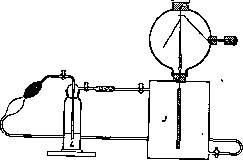
saturation 1.73·103 CGSE. In the case of an infinitely thin layer (e.g., active deposit obtained in the presence of emanation on solid bodies and consisting of its decay products), ionization is proportional to the amount of the radioelement on the preparation. 2) Measurements by γ-rays. Due to the high penetrating power of γ-rays, it is possible to measure the amount of radioelements (usually Ra, RaEm, or MsTh) in hermetically sealed preparations with their help. Measurements are performed by comparison with a standard containing a known amount of Ra. When measuring small amounts of Ra on the order of 10-6–10-7 g, they are placed inside a device of special design. When measuring large amounts—from 10-4 g and above—the test preparation is placed at some distance outside the device. 3) Measurements of small amounts of RaEm are performed by α-rays in an electrometer with an ionization chamber adapted for introducing Em into it. Usually, one has to measure Em from an aqueous solution; in this case, Em is distilled into the ionization chamber with a stream of air by means of circulation (Figure 6) or by some other method. Next, the ionization caused by the α-rays of Em and its decay products is measured. Thus, for example, the content of RaEm in spring water is determined. This same method is used when determining small amounts of Ra in solution. The solution under investigation is placed in a gas-washing bottle L and freed from Em by blowing air through it for 10–30 minutes. Then the vessel with the solution is hermetically sealed and left for several days for the accumulation of Em. Next, the Em is transferred to the measuring device J, where its quantity is determined. The accumulation of emanation occurs according to the formula E=E∞(1-e-λt), where E is the amount of Em accumulated during time t, and E∞ is the amount of it in equilibrium with radium in the given solution. Numerically, E∞ is equal to as many curies of emanation as there are grams of Ra in the solution. A solution with a known Ra content on the order of 10-8–10-9 g serves as a standard. By means of Em, it is possible to measure 10-10 g and even 10-12 g of Ra. 4) The measurement of the number of individual particles is performed either by the scintillation method or by appropriate amplification of the ionizing action of individual particles or impulses (Geiger counter). Artificial radioactivity. By bombarding atomic nuclei with rapidly moving particles, it is possible to produce artificial transmutation of elements. The "projectiles" for such bombardment can be α-particles of radioelements, which, upon a successful hit on atomic nuclei, knock out their constituent elements, mainly H-particles (hydrogen nuclei). This phenomenon was discovered in 1919 by Rutherford. The reverse case is also possible—the synthesis of a new element due to the sticking of the bombarding particle in the nucleus. When bombarding atomic nuclei with fast protons obtained in strong electric fields, Cockcroft was the first to observe the artificial transmutation of elements with the emission of α-particles. In this process, a lithium nucleus, for example, by attaching a proton, turns into two helium nuclei. Work with artificial radiations has begun in a number of countries and is leading to success with rapid steps, opening up new and very great possibilities in the study of the atomic nucleus and on the path to attempts to master intra-atomic energy. The main measurement method used in the study of artificial transmutations of elements and processes associated with the passage of individual rays through matter is the method of the Wilson cloud chamber,

Figure
chamber, which is based on the property of water vapor to condense on ions and makes it possible to observe and photograph the paths of individual particles (Figure 7). Similar results are given by the use of photographic plates with a thick emulsion layer (L. V. Mysovsky's method). A Geiger counter is also used.
Related articles
Mentioned in
Cite this page
“Radioactivity.” Soviet Medical Encyclopedia. English translation of Bolshaya Meditsinskaya Entsiklopediya, 1st ed. (Moscow, 1928–1936), ed. N. A. Semashko. https://sovietmedicalencyclopedia.com/article/radioactivity/