Necatoriasis
Historical document, translated for reference. It reflects medical knowledge of the 1920s–30s and is not medical advice.
Summary
A 1930s medical overview of necatoriasis, a parasitic disease caused by the nematode Necator americanus. It details the parasite's anatomical differences from the related hookworm (Ankylostoma duodenale), its geographical distribution, and historical treatment methods using carbon tetrachloride and oil of chenopodium.
Encyclopedia article (1928–1936)
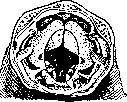
NECATORIASIS, a disease caused by the nematode Necator americanus (Stiles, 1902), belonging to the family Ankylostomidae. Its site of localization is the small intestine. It differs from the hookworm (Ankylostoma duodenale), which causes a clinically similar disease, by the following details of anatomical structure: 1. Its oral capsule is less powerful and is armed, in contrast to the hookworm, not with teeth, but with a pair of cutting plates. 2. The copulatory bursa of the male necator is significantly narrower than that of the hookworm and has the shape of a tulip (the hookworm has a bell shape). 3. The spicules of the necator have appendages in the form of a knitting hook at the end (in the hookworm, they end sharply). 4. The vulvar opening in the necator itself lies in the anterior half of the body (in the hookworm, at the border of the posterior and middle third). 5. The tail end of the female necator does not have the awl-shaped spine present in female hookworms. Both these species were first distinguished in 1902 by Stiles, who pointed out that the diseases termed tropische Chlorose, Gottardtunnelanämie, anémie des mineurs, cachexia africana, etc. (see Hookworm), are caused not only by the hookworm but also by a worm similar to it in anatomical structure, which is widely distributed in the USA and therefore received the name Necator americanus (see figure). The primary source of N. is apparently Central Africa, where it was discovered in dwarf tribes living in complete isolation. From Africa, necatoriasis was brought to the USA during the period of active slave trade and, thanks to suitable climatic conditions, established a firm foothold there. According to old data, N. is distributed in the zone lying between 30° south and north latitude. This zone includes the states of Missouri, Oklahoma, Texas, and California. Mexico is quite heavily affected, and Puerto Rico is very heavily affected. In South America, N. is distributed in all tropical and subtropical regions, with Paraguay being particularly heavily affected. In addition, N. has been confirmed on a whole series of islands: Sumatra,
Java, Samoa, etc. Among immigrants from East Asia, Glover discovered 63% were necator carriers. The degree of infestation of the listed regions with ankylostomids varies: from 60% to 100% of the population, with pure Necator americanus infestation accounting for 80-90% of the total number, and the remaining 10-20% relating to pure Ankylostoma duodenale infestation and mixed Ankylostoma duodenale + Necator americanus. Starting from 1923, necatoriasis has also been registered on the territory of the USSR, first in western Georgia (Partsvanidze), then in Abkhazia (Blazhin, 1925), Adjara (Mchedlidze, 1925), and Azerbaijan (1927). In Abkhazia, Adjara, and Azerbaijan, with a general infestation rate with ankylostomids of 40% to 90%, Necator americanus (pure infestation) accounts for 75% to 95% of the total number of ankylostomids. In western Georgia, and especially in the Zugdidi and Senaki districts, a rather significant admixture of Ankylostoma duodenale is observed. The biology of Necator americanus and Ankylostoma duodenale and the clinical presentation of N. and ancylostomiasis are still considered almost identical (see Hookworm). Only a more severe course of ancylostomiasis is noted, with the greater power of the fixation and wounding apparatus and greater resistance to anthelmintics being of significance. The most favored therapeutic agent is a mixture of CCl4 and Ol. Chenopodii; with a single administration, it expels 99.7% of Nec. am. and 80.0% of Ank. duod. (Soper, 1925). Prescription: CCl4 - 2 volumes + Ol. Chenopod. - 1 volume; for adults 2.5-3.0 + 40.0 of Epsom salts in a concentrated solution. For children, 1/18 of the adult dose per year of age; the treatment is repeated after 10-12 days. The Abkhaz Tropical Institute uses Thymol 8-10 g per day for an adult, 3 days in a row, 2.0 g every hour. One hour after the last dose, a laxative salt 30-40 g. For children 5-7 years old - 2.0 g; 7-9 years old - 3.0 g; 9-12 years old - 4-5 g; 12-15 years old - 6.0 g.
Related articles
Mentioned in
Cite this page
“Necatoriasis.” Soviet Medical Encyclopedia. English translation of Bolshaya Meditsinskaya Entsiklopediya, 1st ed. (Moscow, 1928–1936), ed. N. A. Semashko. https://sovietmedicalencyclopedia.com/article/necatoriasis/