Xeroderma Pigmentosum
Historical document, translated for reference. It reflects medical knowledge of the 1920s–30s and is not medical advice.
Summary
This article from the 1928–1936 Soviet Great Medical Encyclopedia describes xeroderma pigmentosum as a rare, chronic, and progressive genetic skin disease characterized by extreme sensitivity to sunlight. It details the clinical progression from skin dryness and pigmentation to atrophy, ulceration, and malignant tumor formation, noting that the condition is typically inherited as an autosomal recessive trait.
Encyclopedia article (1928–1936)
XERODERMA PIGMENTOSUM (from the Greek xeros—dry and derma—skin) (synonyms: melanosis lenticularis progressiva, epitheliomatosis pigmentosa, liodermia essentialis cum melanose et teleangiectasia, atrophoderma pigmentosum et atrophic, parched skin), a disease described for the first time and with almost exhaustive completeness in 1870 by Kaposi. Xeroderma pigmentosum is encountered rarely. According to the calculations of Siemens and Kohn, from 1870 to 1925, only 333 cases in 222 families were described in world literature, with 146 cases being isolated within a family and 187 being multiple (in 76 families). Men and women fall ill with equal frequency. Characteristic signs of the disease are dryness and pigmentation of the skin. Subsequently, these symptoms are joined by peeling, atrophy, cicatricial changes, telangiectasias, fissures, ulcerations, and eczematization [see separate plate (Vol. XIV, pp. 231–232), Fig. 7], blepharitis with loss of eyelashes and subsequent formation of keratitis, atresia buccalis, and finally, epithelial formations develop, which usually undergo malignant cancerous degeneration. Cases have been described where connective tissue neoplasms of the angioma, sarcoma, and other types developed. The disease usually begins in the first three years of life (80% of all cases), more rarely in youth, and extremely rarely in adulthood (Terebinski's case—onset at age 31; Favre's case—at age 64). The first signs of the disease are often discovered in the spring and summer months, and in some cases, the development of typical xeroderma pigmentosum is preceded by dermatitis of the solar erythema type. The course of the disease is always chronic, steadily progressive, with periods of improvement and remission.
According to Siemens, two-thirds of all patients with xeroderma pigmentosum die before the age of 15. However, cases have been described where the pathological process halted at the age of 20–30, and patients lived to old age (Schü's case—up to 60 years; Matzenauer's case—up to 66 years; and the Herxheimer-Hildebrand case—up to 70 years). Histological examination: chronic inflammation resulting in atrophy, abundant deposition of pigment, formation of new blood vessels, disintegration of elastic and connective tissue fibers, and atypical proliferation of epithelium in the form of cancerous tumors.
Etiology and pathogenesis. Xeroderma pigmentosum is a genotypic disease inherited as an autosomal recessive trait. According to Siemens, in 17% of all described cases, consanguinity is noted. In cases where the genealogy was carefully investigated, this percentage rose to 59. Consanguinity was noted in the case that Olesov had occasion to observe at the skin clinic of the 1st Moscow State University (Fig. 1). An interesting case was described by Velhagen: three healthy brothers married three healthy sisters; in two of these marriages, some of the children turned out to be ill (Fig. 2).
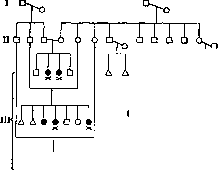
Xeroderma pigmentosum is clinically manifested only in homozygotes, i.e., only in the case where the predisposition to this disease is inherited simultaneously from both the mother and the father; in those cases where the predisposition is received from only one of the parents (in heterozygotes), no clinical manifestations of the disease are noted. The usual onset of xeroderma pigmentosum after prolonged stays in the open air and especially after the first insolation is explained by the increased sensitivity of the skin to ultraviolet rays of any wavelength, with their effect on the skin being slow and deeper; altered skin sensitivity in xeroderma pigmentosum has been noted to X-rays and alpha-rays, while sensitivity to the solar spectrum and chemical irritants is normal (Martenstein). The blood does not contain photodynamic substances (hematoporphyrin, etc.), and its injection into the vein of animals does not sensitize them. Thus, ultraviolet rays as an external factor are the developer of the gene causing xeroderma pigmentosum. Diagnosis of the disease, in the presence of clinical manifestations, does not present difficulties. It must be differentiated from freckles, scleroderma, and sometimes from leprosy. Treatment is symptomatic—it aims to protect the skin from the action of the sun's rays, for which hats, gloves, and skin-protecting ointments and pastes containing quinine and tannin are recommended. Tumors are removed surgically, by radium, X-rays, and electrolysis.
Related articles
Mentioned in
Cite this page
“Xeroderma Pigmentosum.” Soviet Medical Encyclopedia. English translation of Bolshaya Meditsinskaya Entsiklopediya, 1st ed. (Moscow, 1928–1936), ed. N. A. Semashko. https://sovietmedicalencyclopedia.com/article/xeroderma-pigmentosum/