Sycosis
Historical document, translated for reference. It reflects medical knowledge of the 1920s–30s and is not medical advice.
Summary
Sycosis is a chronic, superficial, staphylococcal folliculitis primarily affecting the hair-bearing skin of men, particularly on the face. This 1930s encyclopedia entry details its clinical presentation, etiology, and treatment methods, including the use of radiotherapy and topical disinfectants.
Encyclopedia article (1928–1936)
SYCOSIS, sycosis vulgaris, s. simplex, s. staphylogenes, s. non parasitaria (from the Greek sykon—fig), is a chronic superficial follicular staphyloderma, observed almost exclusively in men on the hair-bearing parts of the face, and more rarely in the axillary regions, on the pubis, and on the scalp (see separate table, fig. 1). The so-called parasitic sycosis is a deep trichophytosis, sometimes similar due to its localization and clinical picture to ordinary sycosis. The etiology of sycosis is complex and not yet fully clarified. The microbial flora of the process is Staphylococcus aureus, more rarely white staphylococcus, which is indistinguishable from ordinary staphylococci by modern research methods. There is, however, no data proving the contagiousness of sycosis as such or explaining the chronicity of the course and the tendency to relapse by special properties of the pyococci. It is therefore necessary to think that there are some prerequisites in the organism itself that determine the disease of sycosis. Cases of generalized sycosis with lesions of the face, axillary regions, pubis, etc., indicate a systemic lesion of the follicular apparatus. It is possible that various factors (nervous, endocrine, etc.) create corresponding biochemical prerequisites in the follicles for the reproduction and persistent existence of pyococci. The social significance of sycosis is determined by its frequency and its role as a factor of temporary disability. Among 1,044 admissions of male patients with various forms of pyoderma in 1928–32 to the hospital named after Tarnovsky in Leningrad, sycosis patients accounted for 29.1%, with 9,634 workdays lost, and the average duration of stay for patients who were hospitalized once was 30.5 days. From a pathological-anatomical point of view, sycosis is characterized by the development of an intrafollicular pustule, occupying the funnel of the hair follicle and rarely a deeper one. The walls of the follicle are never destroyed, but can be permeated by a significant number of segmented leukocytes. Perifollicular infiltration usually has a round-cell character. In old cases, phenomena of chronic inflammation are found in all layers of the skin.
The pathogenesis of sycosis basically boils down to the infection of hair follicles by pyogenic staphylococcus, and the duration of the course and relapses are explained either by the lack of development of immunity within the follicles or by its periodic fluctuations. Along with the recognition of exogenous infection of follicles by pyococci, one cannot deny the possibility of the mutation of non-pathogenic staphylococci, which are always present in the follicles, into pyogenic forms. Various biochemical intrafollicular processes, which depend on nervous, endocrine, and other factors, as well as external influences traumatizing the mouth of the follicles, can contribute to this assumed mutation. Acute relapses, occurring suddenly on a large surface and in many localizations, speak in favor of this possibility. The influence of occupation (lubricating oils, dust, etc.) is undoubted, but it is not decisive and affects most likely those predisposed to the disease. In this same sense, one can understand the role of chronic rhinitis, preceding facial eczema, etc.
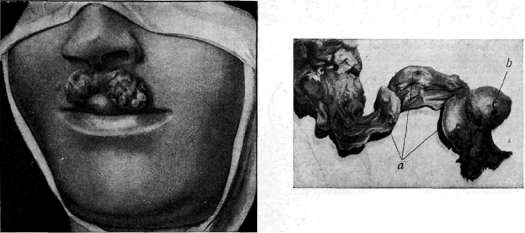
Course and symptoms. Depending on the localization, spread, and outcome of sycosis, several clinical types are distinguished, connected by transitional forms. The most frequent clinical form is sycosis of the upper lip. Often, chronic rhinitis is also found with it. The course is chronic, usually recurring in separate outbreaks, between which more or less long remissions are possible. In the acute stage, superficial follicular pustules predominate, pierced in the center by a hair, sitting on a background of inflamed, hyperemic skin. The contents of the rupturing pustules dry into crusts that merge with each other, and inflammatory phenomena between the follicles can intensify to the degree of weeping, simulating the picture of eczema (eczematized sycosis). A combination with phenomena of seborrheic eczema is also possible, especially in the eyebrow area (sycosiform eczema). In the subacute stage, infiltrative phenomena predominate: the number of pustules can be very insignificant, but there is bran-like desquamation on a background of reddened and thickened skin. In other cases, deeper dense furunculoid infiltrates or more superficial soft-elastic nodules that protrude above the skin level are formed. On the scalp, sycosis resembles impetigo, differing from it by the duration of the course and the persistence of relapses. The so-called dermatitis papillaris capillitii of Kaposi is apparently a variety of sycosis and is characterized by the formation of dense nodules and plaques of a pale or violet-red color on the back of the neck and the adjacent part of the scalp. Generalized sycosis is characterized by lesions not only of the face, axillary regions, and pubis, but also of the lower extremities. Lymphadenitis is observed very rarely in sycosis. The duration of the disease and its persistence in relation to therapy can affect the patient's psyche and be the cause of a neurasthenic-hypochondriacal symptom complex.
Diagnosis is based on characteristic morphological signs and the course of the disease. It is important to distinguish ordinary sycosis from the so-called parasitic sycosis. The latter is characterized by asymmetrically located, sharply demarcated, rounded plaques of bright red color that protrude above the skin level. To the touch, they are dense, and when pressed from the sides, abundant drops of pus are squeezed out from the mouths of the follicles. The hair on the surface of the plaque usually thins out significantly, breaks off, or even falls out completely. The causative agent is, as a rule, a fungus of animal origin. Sycosis differs from eczema by the predominance of follicular inflammatory nodules and pustules in the clinical picture. It also differs from impetigo by this, as well as by the duration of the course. It should be kept in mind, however, that eczema and impetigo of the hair-bearing parts of the face can trigger the development of sycosis. The prognosis of sycosis regarding complete recovery is doubtful. However, it is almost always possible to achieve a cosmetic effect and maintain this effect. Thus, from the point of view of work capacity, the prognosis is favorable, although the possibility of relapse should always be kept in mind.
Treatment of sycosis does not yet have methods that guarantee a final cure and the prevention of relapses. Therefore, the goal of therapy is for now the fastest possible cosmetic effect and the quickest restoration of work capacity. Specific therapy (auto- and polyvaccine) has only auxiliary significance. Filtrates according to Besredka do not give special results. Among physiotherapeutic procedures, X-ray therapy is significant, used either for the purpose of epilation or in fractional doses, as in the treatment of eczema. Epilation of the affected areas (X-ray or manual) gives the best results in combination with subsequent disinfecting local therapy. For the latter, dyes (gentian or methyl violet or brilliant green) can be especially recommended, used in the form of ointments (1%), aqueous compresses (1:1000), and 70° alcohol solutions for smearing (1%). Electrophoresis with an aqueous solution of dye also gives good results. Sulfur preparations in the form of ointments or rubs are also of great importance. Tar preparations are also used. In acute cases, compresses (Burow's solution, aqueous solution of dye, etc.) are appropriate. To prevent relapses, frequent shaving and daily wiping of the affected areas with 70° alcohol for a long time are recommended. Existing rhinitis should be subjected to thorough therapy. Work in dusty and metalworking professions associated with the use of lubricating oils is contraindicated in sycosis, and therefore it is advisable to transfer patients with persistent relapses to other work.
S. Rosenthal.
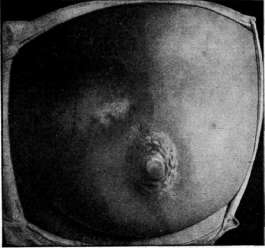
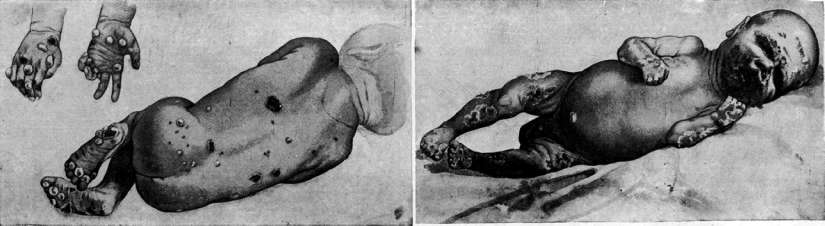
Figure 1, Sycosis parasitaria. Figure B. Aneurysm (b) of the splenic artery (a). Figure 3, Sclerodermia en plaques. Figure 4. Congenital syphilis. Figure 5. Congenital syphilis.
Related articles
Mentioned in
Cite this page
“Sycosis.” Soviet Medical Encyclopedia. English translation of Bolshaya Meditsinskaya Entsiklopediya, 1st ed. (Moscow, 1928–1936), ed. N. A. Semashko. https://sovietmedicalencyclopedia.com/article/sycosis/