Schick Test
Historical document, translated for reference. It reflects medical knowledge of the 1920s–30s and is not medical advice.
Summary
This 1930s encyclopedia article discusses the Schick test, proposed in 1913 to determine susceptibility to diphtheria through intradermal injection of diphtheria toxin. It details the procedure, interpretation of positive, negative, false, and combined reactions, and its epidemiological value in assessing immunity.
Encyclopedia article (1928–1936)
SCHICK TEST (Schick) was proposed in 1913 to determine the degree of susceptibility to diphtheria. The Schick test is performed by strictly intradermal injection of diphtheria toxin in a volume of 0.2 cm3, containing 1/40 Limiting Diphtheria Dose (see Diphtheria). The toxin is injected into the skin of the left arm; into the skin of the right arm, an equal amount of toxin heated at 100° for 10 minutes is injected as a control. The results of the injection are noted after 24 and 96 hours, during which the following phenomena may be observed: 1. With a complete absence of reactive phenomena at the site of injection of the "control" (heated) toxin, redness and infiltrate appear at the site of injection of the active toxin, accompanied by a sensation of mild burning and itching. These phenomena develop in the first 24 hours, reach a maximum on the fourth day, and then disappear, leaving skin pigmentation for some time. Based on the size of the redness and infiltrate, one can judge the degree of the reaction, which is designated as follows: + ("doubtful" reaction with indistinctly expressed infiltrate and slight redness), ++ (with redness no more than 1.5 cm in diameter), +++ (if the redness has a diameter from 1.5 to 3 cm) and ++++ (if the redness is greater than 3 cm); this type of reaction is called a "positive" Schick test. 2. In the absence of any reactive phenomena at the site of injection of both the heated and active toxins, it is called a "negative" Schick test. 3. If reactive phenomena are noted on both arms to an equal degree, then such a phenomenon is designated as a "false" Schick test. The degree of the false (with heated toxin) reaction is noted (like the positive one) with one, two, or three signs. The reaction to the heated toxin has some qualitative differences from the reaction to the active toxin: rapid appearance and disappearance (usually within 36–48 hours) and the predominance of exudative phenomena over infiltrative ones. 4. If reactive phenomena are noted on both arms, but their degree is different, then it is called a "combined" Schick test—with the predominance of phenomena on the side of the active toxin, and a "perverted" Schick test—with the predominance of phenomena on the side of the heated toxin. General ideas about the essence of the Schick test boil down to the following: if there is no antitoxin in the blood of the tested subject, or if it is contained in an amount less than 1/30 Antitoxin Unit in 1.0 of serum, then the intradermally injected toxin causes reactive phenomena, designated as a "positive" Schick test. If, however, a sufficient amount of antitoxin is present in the blood of the tested subject (according to Schick 1/30, according to Behring 1/500 and more Antitoxin Units in 1.0 of serum), then the latter neutralizes the introduced toxin, and a "negative" Schick test is obtained. These propositions are confirmed by the following observation: if a neutral "toxin-antitoxin" mixture is injected into a subject sensitive to diphtheria toxin, as a rule, no reaction is observed at the site of injection of this mixture. In addition, a whole series of simultaneous direct determinations of the amount of antitoxin in the blood according to Römer's method was carried out in parallel with the Schick test (Schick, Ramon, Weksler, and others). In most cases, these experiments reveal the noted dependence of the Schick test result on the amount of antitoxin in the blood. The discrepancies sometimes observed between these phenomena cannot shake the general rule, since they occur quite rarely: Jensen, for example, noted the presence of negative Schick tests with a negligible antitoxin content (1/100 Antitoxin Unit in 1.0 of serum) in 9% of cases. When evaluating the results of the Schick test, it must be taken into account that in early infancy, a negative Schick test is often observed in the absence of antitoxin in the blood. This is explained by the skin anergy inherent in early childhood. As for the so-called false Schick test and its variants (combined, perverted Schick test), i.e., the skin reaction to the heated toxin, it is explained by the body's sensitivity to thermostable metabolic products of the diphtheria bacillus and nutrient broth substances. This sensitivity is of an allergic character. As Siegl showed, it consists of two components—specific and non-specific in relation to diphtheria. Observations by Zoller showed the complete identity of the false reaction with the intradermal reaction to anatoxin (0.2 anatoxin diluted 1:100)—this is the so-called Zoller reaction. Depending on the result of the reactions to the toxin and anatoxin, Zoller divides all people into 4 groups (see table). Zoller conceives the process of immunization against diphtheria as follows: diphtheria-susceptible individuals (Group I with a positive Schick test) upon encountering the diphtheria bacillus (disease or carriage) or upon artificial immunization become sensitized to the microbe and its products. Their skin gives an allergic reaction; but since a sufficient amount of antitoxin has not yet been produced, the skin also reacts to the active toxin (Group II with a false or combined Schick test). Subsequently, the amount of antitoxin in the blood increases so much that the reaction to the active toxin becomes negative, but the allergy still remains (Group III with a perverted Schick test); finally, the latter disappears, and a strong immunity sets in, characteristic of individuals of Group IV (with a negative Schick test). The significance of the Schick test as an immune reaction is determined by the prevailing views on the nature of immunity in diphtheria. According to modern concepts, the basis of the latter is the presence of a sufficient amount of antitoxin in the blood. These concepts, as is known, determine the modern practice of immunization prophylaxis of diphtheria (toxin-antitoxin mixtures, anatoxin). From this point of view, the Schick test, which conveniently replaces the cumbersome direct determination of antitoxin in the blood according to Römer's method, can be considered an ideal way to determine the state of immunity, resp. sensitivity, of a person to diphtheria. The question of the minimum amount of antitoxin in the blood required for the implementation of solid immunity to diphtheria is controversial; in any case, it is necessary to note the comparative rarity of diphtheria disease in individuals who have a negative Schick test; in addition, one can point to direct experimental confirmation of this question: Guthrie, Marshall, and Moss infected eight volunteers by swabbing the pharynx with a virulent diphtheria culture, of whom four had a positive Schick test and four had a negative one. As a result, 4 individuals of the first group developed a typical disease, while out of 4 people with a negative Schick test, 3 showed temporary carriage of the diphtheria bacillus without any signs of disease. A huge number of works are devoted to the epidemiological significance of the Schick test. From them it is clear that the Schick test represents a reliable method for determining the degree of the immune stratum of a collective in relation to diphtheria. It turned out that if positive Schick tests are distributed by age, a curve (Zingher) of age-related sensitivity to diphtheria is obtained, which quite accurately coincides with the age distribution of diphtheria incidence. The relatively high immunity of infants of early age (up to half a year) can be explained by the passive transfer of immune bodies through the mother's milk. As for the drop in sensitivity to diphtheria with age (starting from one year), accompanied by the accumulation of antitoxin in the blood, some authors (Friedberger et al.) consider this phenomenon an expression of "physiological serogenesis," i.e., that the accumulation of antitoxin proceeds in a physiological order, thus accompanying the maturation of the human organism, while other authors (Zingher, Dudley, Ramon, et al.) believe that people accumulate antitoxin in the blood as a result of an obvious, and more often "silent infection" with diphtheria (see figure). The epidemiological value of the Schick test also lies in the fact that it is convenient to use for the selection of individuals subject (in case of a positive result) to active immunization against diphtheria. It is usually used in children.
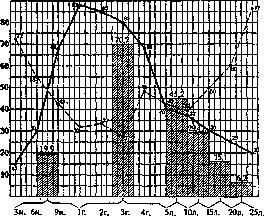
Distribution by age: percentage of persons having antitoxin in the blood (according to Greer); percentage of persons with a positive Schick reaction (according to Park and Zingher); columns represent diphtheria morbidity. In ages over 5 years, keeping in mind the relative rarity of a negative Schick reaction in children under 5 years of age. Finally, the Schick reaction is also used as an objective control of the effectiveness of preventive vaccinations against diphtheria. This effectiveness is proved by the transition of a positive (before vaccination) Schick reaction into a negative one after vaccination (usually 6 weeks after the last vaccination). Technique for performing the Schick reaction: 1. In order to prepare the necessary dilution of toxin in the required volume, one proceeds from the minimal lethal dose of the toxin. Suppose the minimal lethal dose of the toxin = 0.0032. To prepare a toxin containing 1/40 of the minimal lethal dose in 0.2 volume, one proceeds as follows: take 100 minimal lethal doses, in this case = 0.32, and add physiological saline up to 10.0, i.e., 9.68. Take 1.0 of this dilution (i.e., 10 minimal lethal doses) and add it to 79.0 of physiological saline. Then in 80.0 of the second dilution there are 10 minimal lethal doses; in 1 cm3, consequently, 1/8 of the minimal lethal dose, and in 0.2, 1/40 of the minimal lethal dose. For each dilution, it is necessary to take a fresh dry pipette, rinsing it at least 10 times. At the same time, special precision in measuring and accuracy of the pipettes are necessary (half of the toxin dilution prepared in this way is poured into a separate flask and placed in a boiling water bath for 10 minutes; in this way, heated toxin is obtained for "control"). In view of the fact that toxin diluted with physiological saline quickly loses its activity, it is more convenient to use the so-called borate-buffer solution for dilution (see Dick test), in which the diluted toxin retains its potency for several months. 2. The injection is performed strictly intracutaneously, most conveniently using a tuberculin syringe with a very thin platinum needle (No. 18, 19). The needle should have a short bevel. The bevel during the injection should be kept facing outward. The introduction of the toxin is accomplished slowly with a certain tension, characteristic of the intracutaneous introduction of liquid, and as a result, a well-demarcated blister (Quaddel) is formed at the injection site, having depressions at the site of the hair follicles. 3. The injection of the active toxin is performed into the skin of the forearm of the left hand, and the heated toxin is injected into the skin of the forearm of the right hand. During mass performance of the Schick reaction, it is recommended to be carried out by two doctors simultaneously—one injects the active, the other the heated toxin. 4. Reading of the Schick reaction is performed twice: after 24 hours to account for pseudo-reactions and after 96 hours, when the true Schick reaction reaches its culmination point.
Related articles
Cite this page
“Schick Test.” Soviet Medical Encyclopedia. English translation of Bolshaya Meditsinskaya Entsiklopediya, 1st ed. (Moscow, 1928–1936), ed. N. A. Semashko. https://sovietmedicalencyclopedia.com/article/schick-reaction/