Dynamoscope
Historical document, translated for reference. It reflects medical knowledge of the 1920s–30s and is not medical advice.
Summary
The dynamoscope, designed by K. N. Kornilov, is an apparatus used to investigate the dynamic and motor aspects of human reactions. It records the force, path, and duration of a muscular response using a pressure-sensitive key connected to a mercury manometer and a kymograph.
Encyclopedia article (1928–1936)
DYNAMOSCOPE of Kornilov, K. N., an apparatus for investigating the dynamic and motor aspects of human reactions. The components of the dynamoscope (see figure) include a reaction key with a rubber bulb enclosed within it, and a two-armed mercury manometer equipped with a writing pen. When reacting, the subject depresses the key; the force impulse
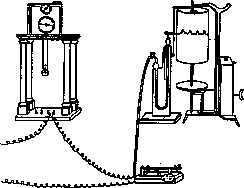
is transmitted to the bulb and further through a tube to the manometer, whose pen records a specific curve on a kymograph tape. Knowing the speed of the kymograph movement and the radius of the manometer opening, one can easily calculate from the resulting curve the energy expended during the reaction, the path traveled by the reacting organ, and the time of its movement.
The dynamoscope can be included in a chronoscope circuit, and the reaction time is then measured concurrently. Thus, the dynamoscope makes it possible to account simultaneously for the temporal and motor moments of a reaction. The dynamoscope was manufactured in Germany by the Spindler & Hoyer firm.
Related articles
Cite this page
“Dynamoscope.” Soviet Medical Encyclopedia. English translation of Bolshaya Meditsinskaya Entsiklopediya, 1st ed. (Moscow, 1928–1936), ed. N. A. Semashko. https://sovietmedicalencyclopedia.com/article/dynamoscope/