Craniometry
Historical document, translated for reference. It reflects medical knowledge of the 1920s–30s and is not medical advice.
Summary
Craniometry is the measurement of the dimensions of the skull and head using specialized instruments such as sliding calipers, dioptographs, and craniostats. This article from the 1928–1936 Soviet Great Medical Encyclopedia details the standard tools and techniques used in anthropological and medical cranial measurements.
Encyclopedia article (1928–1936)
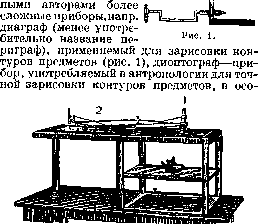
CRANIOMETRY (from Greek cranion - skull and metron - measure), the measurement of the dimensions of the skull and head. The simplest and most common craniometer is the sliding caliper, the legs of which, when closed, touch each other tightly only over the median portion of the instrument, after which they diverge to the sides, bending in an arc, and meet again on the midline. The legs of the caliper are connected by a hinge. The curved parts are rounded and end in a button-shaped thickening. A transverse ruler extends from the hinge, fixed to one of the legs by a pin allowing its free movement. A metal box rotating on a pin is also attached to the corresponding place of the opposite leg, the front wall of which is replaced by a plate with an edge beveled toward the zero division, serving for reading. A scale with divisions is applied to the ruler, corresponding precisely to the divergence of the caliper legs. The number of divisions on the ruler is 30; the zero point is at the fixed end of the ruler. Precise correspondence of the ruler divisions to the divergence of the caliper legs, good fitting of the sleeve and screws, is required. This description is standard, according to which craniometric calipers are manufactured in the USSR. For the simultaneous measurement of several dimensions of the skull, more complex instruments are used, for example, the cephalometer, the Kreilain apparatus, consisting of a system of elastic plates used for measuring arcs on the heads of living people (see Craniocerebral Topography). For simultaneous measurement and graphic recording of the contours of the human skull in various positions (as well as objects), appliances are used
such as the dioptograph shown here.
Figure 2. Dioptograph: 1 - tube with sighting cross; 2 - pantograph with graphite, drawing the contour of the object.
reflecting the features of human skulls (Fig. 2). There are other instruments used for the same purposes: the craniophore, Kocher's craniostat, and others, which do not have wide practical application.
Related articles
Mentioned in
Cite this page
“Craniometry.” Soviet Medical Encyclopedia. English translation of Bolshaya Meditsinskaya Entsiklopediya, 1st ed. (Moscow, 1928–1936), ed. N. A. Semashko. https://sovietmedicalencyclopedia.com/article/craniometry/