Boluses and Calorimetric Bomb
Historical document, translated for reference. It reflects medical knowledge of the 1920s–30s and is not medical advice.
Summary
This article discusses boluses (referring to pills) and describes the calorimetric bomb designed by Berthelot for determining the heat of combustion of organic substances and performing chemical analyses.
Encyclopedia article (1928–1936)
BOLUSES, see Pills. CALORIMETRIC BOMB, constructed in its modern form by Berthelot, is used to determine the heat of combustion of organic substances (see Calorimetry), and recently also for performing certain chemical analyses associated with the combustion of the test substance in an oxygen atmosphere under increased pressure. The calorimetric bomb is a thick-walled steel cylinder lined on the inside with a layer of platinum, which protects the walls from oxidation. The cylinder is hermetically sealed with a screw-on or clamped nut lid, which has one or two valves for oxygen and an insulated electrode for supplying a current that heats a thin iron wire and causes the ignition of the test substance. The latter is placed in a small cup fixed by means of a rod to the lid of the bomb. The ignition wire is also introduced here. Having hermetically secured the lid on the calorimetric bomb, oxygen is admitted to a pressure of about 20 atmospheres and the substance is ignited by switching on the current.
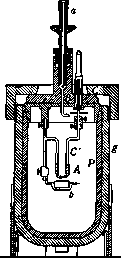
Calorimetry, bomb: a - tube for oxygen intake; A - ignition wire; b - cup for the substance; B - ground-in lid; C - nut clamping the lid; c - electrode; P - platinum lining; d - steel body of the bomb.
At present, bombs have been produced in which the platinum lining is replaced by a special enamel, as well as bombs made of special non-oxidizing steel.
Related articles
Mentioned in
Cite this page
“Boluses and Calorimetric Bomb.” Soviet Medical Encyclopedia. English translation of Bolshaya Meditsinskaya Entsiklopediya, 1st ed. (Moscow, 1928–1936), ed. N. A. Semashko. https://sovietmedicalencyclopedia.com/article/boluses/