Autofocus Tube
Historical document, translated for reference. It reflects medical knowledge of the 1920s–30s and is not medical advice.
Summary
This article from the 1928–1936 Great Medical Encyclopedia describes the autofoktrubna, an X-ray tube whose focal spot area automatically changes in accordance with the tube load. The adjustment is achieved through a specialized electrode design that controls electron dispersion based on the current passing through the tube. This mechanism protects the anticathode from rapid destruction under heavy loads by distributing the electron energy over a larger surface.
Encyclopedia article (1928–1936)
AUTOFOCUS TUBE, an X-ray tube whose focus area automatically changes in accordance with the change in the tube load. The automatic change of the focus area is achieved by means of a device schematically shown in the figure. In the middle of the turns of a conventional flat cathode spiral, perpendicular to its plane, a rod S, isolated from the turns, is fixed. The high voltage of the transformer cathode is supplied to the rod S directly, and to the turns of the spiral through a large resistance R. When the tube is operating, the rod will always have a somewhat greater negative potential relative to the spiral, and this potential difference must depend on the strength of the current flowing through the tube. Let the resistance R = 10,000 ohms; then, at a current through the tube of 100 mA, the potential drop in the resistance R will be (according to Ohm's law) 1,000 volts. By this amount, the potential of the rod will be higher than the potential of the spiral. At a current through the tube of 1 mA, the difference between the negative potentials of the rod and the spiral will be only 10 volts.
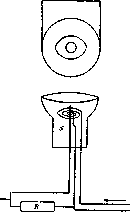
The rod S, possessing a higher negative potential than the spiral, will always affect the nature of the path of the electrons of the spiral in such a way that in their movement toward the anticathode they will be somewhat scattered, forming a focus with a larger area. This increase in the focus area will be greater the more the potential of the rod exceeds the potential of the spiral, i.e., this will occur, as indicated above, at high tube loads. The increase in the dimensions of the focus at high loads protects the anticathode of the tube from rapid destruction, since in this case the energy lost by the electrons is distributed over a larger surface.
V. Karchagin.
Related articles
Cite this page
“Autofocus Tube.” Soviet Medical Encyclopedia. English translation of Bolshaya Meditsinskaya Entsiklopediya, 1st ed. (Moscow, 1928–1936), ed. N. A. Semashko. https://sovietmedicalencyclopedia.com/article/autofocus-tube/