Apraxia
Historical document, translated for reference. It reflects medical knowledge of the 1920s–30s and is not medical advice.
Summary
This article defines apraxia as a disorder of learned motor actions, distinguishing between ideational and motor forms. It discusses the neurological localization of these deficits, particularly in relation to the left hemisphere and the corpus callosum, and notes that treatment focuses on the underlying pathology.
Encyclopedia article (1928–1936)
APRAXIA (from the Greek a-negative particle, and praxis-action), a disturbance of the ability to "act," i.e., to use innate synergies and mechanisms for performing certain learned actions; for example, when preparing to smoke, an apraxic patient may bring an unlit match to their mouth or place the matchbox on their head, while sticking the match into their mouth, or hold it helplessly in their hand while opening their mouth, or wave their hand. Apraxia is not always expressed so sharply; sometimes the patient succeeds in the action. Sometimes apraxia is discovered only during special examinations. For this, the patient is asked to: 1) perform some mimetic movement—beckon someone with their hand, shake a finger; 2) reproduce actions from memory, demonstrate: how to swim, how to eat soup, how to hammer a nail, etc.; 3) perform manipulations with some objects—light a cigarette, light a candle, peel an apple, seal a letter, comb hair, etc.; 4) perform simple movements—close eyes, stick out tongue, raise arm, bend legs, etc.; 5) perform so-called mutual, "reflective" movements—place a hand on the head, on the right ear, on the back of the head, etc.; 6) imitate actions. In severe cases, none of the indicated actions succeed; sometimes they succeed, but with difficulty, with errors, and awkwardness. Sometimes one action is replaced by another, individual links are skipped, and sometimes "amorphous movements" are performed. Often, the correct action is hindered by perseveration, i.e., the intrusive, stereotypical repetition of a just-performed action. Sometimes it initially seems that patients suffer from sensory aphasia (see) or do not recognize the object, or that they are mentally ill. But it is usually easy to verify the opposite by forcing the patients to act with non-apraxic parts of the body. Apraxia can be recognized only if the incorrect action is not caused by sensory aphasia, mental illness, or agnosia. It is easiest to clarify this in cases where the patient cannot even imitate movements. But even in the latter case, one must think about the possibility of weakened vision, of hemianopsia (see). Often, apraxia is combined with other cerebral symptoms—with aphasia, agnosia, paresis, and attention disorders (e.g., in Alzheimer's disease; see Alzheimer's disease). Not without reason, motor aphasia can also be recognized as apraxia of the organs of speech. Apraxia can manifest either in all parts of the body, or in one half, or in one limb, or in the muscles of the face. In the latter case, it may consist, for example, only of an inability to close the eyes upon command (apraxia of the eyelids) or an inability to stick out the tongue, etc. It is customary to distinguish between ideational apraxia and motor apraxia. In ideational apraxia, actions are disturbed in all parts of the body. More complex actions suffer, their links fall out; imitation of movements is better preserved. The patient gives the impression of a distracted person. Dejerine called this type "apraxia of intent." Motor apraxia can be bilateral, but more often it affects only specific parts, usually the left hand or the muscles of the face. With it, both simple movements and imitation of movements are disturbed, and amorphous movements and perseveration often arise. The definition "apraxia of execution" is applicable to it. As early as 1866, Jackson described an undoubted case of apraxia. The term was first introduced in 1873 by Gogol. In 1899, de Buck described as parakinesia a picture close to that which Liepmann also drew attention to, who in 1900 described a patient considered a sensory aphasic and mentally ill. Liepmann proved that apraxia is merely a motor disorder, a defect in the area of execution of the action itself, and that, like aphasia, apraxia is connected with the left hemisphere and is caused by the isolation of the left central gyrus from other areas of the brain.
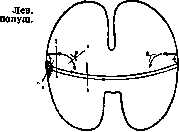
[Diagram caption: Scheme of apraxic disorders: 1—focus in the supramarginal gyrus causes bilateral apraxia; 2—focus causes paralysis of the right hand and apraxia of the left; 3—focus in the corpus callosum leads to apraxia of the left hand; 4—focus in the internal capsule causes right-sided hemiplegia; a—internal capsule (path to the right hand), b—internal capsule (path to the left hand).] A focus in the corpus callosum, which isolates the center of the left hand located in the right hemisphere from the left hemisphere, causes isolated apraxia of the left hand. The question of the localization of bilateral apraxia is still subject to discussion. Hartmann, Goldstein, and others explain it by a focus in the frontal lobes. Krol and Schauffenberg showed that foci in the left supramarginal gyrus in the parietal lobe lead to bilateral apraxia. The latter view is now almost universally accepted. However, Monakow speaks out generally against the localization of apraxia, as well as aphasia, explaining them by diaschisis (see). Consequently, bilateral motor apraxia in a right-handed person suggests a focus in the left supramarginal gyrus, more precisely, in field 40 according to Brodmann, PE according to Economo. Apraxia of the left hand, sometimes combined with paresis of the right limbs, suggests a focus in the corpus callosum. In a left-handed person, on the contrary, bilateral apraxia is caused by a focus in the right hemisphere, and a focus in the corpus callosum causes apraxia of the right hand. Ideational apraxia suggests general cerebral arteriosclerosis with foci in the left hemisphere. An interesting form of apraxia is apparently connected with a focus in the narrow band separating the superior parietal gyrus from the inferior (visual-sensory band or field PBE according to Economo); apraxia in such cases is accompanied by a loss of the ability to distinguish the right side from the left and the involuntary participation in the movement of one hand by other limbs as well, especially the lower one. This concerns insufficient denervation, a disorder in the inhibition of other impulses connected (ontogenetically and phylogenetically) with the action of one limb. A similar disorder of denervation probably lies at the basis of mirror writing, often observed in apraxics, as well as in children and left-handed people (Leonardo da Vinci).
Apraxia is caused by tumors, parasites, circulatory disorders, especially arteriosclerotic softening, syphilis, encephalitis, etc. The prognosis depends on the nature of the underlying disease, age, and the condition of the cerebral vessels. Skull wounds in the last war provided many cases of apraxia with a good outcome, which is explained by the youth of the patients, the limited nature of the focus, good vessels, and perhaps less differentiation of functions in the young. The latter is partly supported by contradictory experiments on trained animals with transection of the corpus callosum. While some authors find that in animals (cats, monkeys) the ability to perform learned actions is lost after transection, others deny this. The underlying disease must be treated. Lit.: Krol M., On the Clinic and Topical Diagnosis of Aphasic and Apraxic Disorders, "Journal of Neuropathology and Psychiatry named after S. S. Korsakov," 1911; Krol M., Beitrage zum Studium der Apraxie, Zeitschr. f. d. ges. Neurol. u. Psych., B. II, 1910; Brun R., Klinische und anatomische Studien uber Apraxie, 1922; Hartmann F., Beitrag zur Apraxielehre, Monatsschr. f. Psychiatrie, B. XXI, 1907; Kleist, Gang und gegenwartiger Stand der Apraxieforschung, Ergebn. d. Neurol. u. Psych., 1911; Liepmann H., Drei Aufsatze aus dem Apraxiegebiete, 1907, 1908; Monakow C., Die Lokalisation im Grosshirn, 1914; Stauffenberg, Klinische u. anatomische Beitrage zur Kenntniss der aphasischen, agnost. u. apraktischen Symptome, Zeitschr. f. d. ges. Neurol. u. Psych., B. XXXIX, 1918.
Related articles
Mentioned in
Cite this page
“Apraxia.” Soviet Medical Encyclopedia. English translation of Bolshaya Meditsinskaya Entsiklopediya, 1st ed. (Moscow, 1928–1936), ed. N. A. Semashko. https://sovietmedicalencyclopedia.com/article/apraxia/